


External rotor fan

Structural features
An external-rotor motor, as its name suggests, features a rotor that rotates on the outside of the motor, while the stator—comprising the windings—remains stationary inside. This configuration is the exact opposite of the conventional internal-rotor motor. When applied to fans, the fan’s rotating blades are directly welded or mounted onto the rotor, resulting in a more compact and aesthetically pleasing overall design compared to fans driven by internal-rotor motors. This approach also reduces the equipment’s footprint and simplifies installation and maintenance.
Market Applications
Cold storage for preservation
Evaporator
Cooling fan
Condensing unit
It serves to provide cooling, heat dissipation, and ventilation.
Common failure mode of external-rotor fans: fretting wear
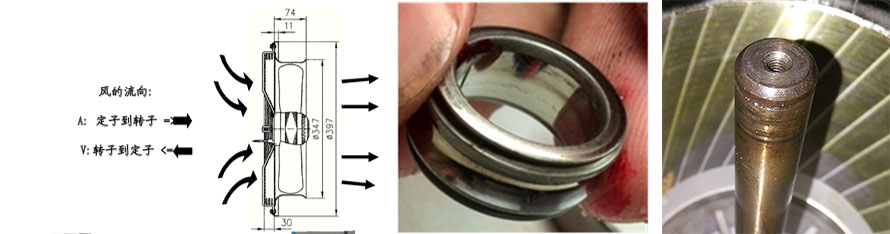
In addition to the starting torque and rotational torque, the root causes of bearing inner‑ring creep include a loose fit between the shaft and the bearing’s inner ring, as well as blade vibration and insufficient axial preload. These factors accelerate fretting wear and creep at the interface between the bearing’s inner ring and the motor shaft, where no macroscopic relative motion occurs, ultimately leading to fan failure.
Creating value for society through fast, professional, and high-quality service.

Chichuang·Hangzhou
Address: Floor 4, Unit 2, Building 10, No. 505 Xingguo Road, Linping District, Hangzhou City
Chichuang·Shenzhen
Address: Room 2405, Building 111, Phase I, Vanke City, Nanbu Bay, Humen Town, Dongguan City
Chichuang·Chongqing
Address: Building 4, No. 5 Huoju Avenue, Jiulongpo District, Chongqing City
Copyright © 2026 Hangzhou Chichuang Shaft Research Technology Co., Ltd.
Factory Address: Building 1, No. 10, Nangonghe Road, Donghu Subdistrict, Linping District, Hangzhou.
Powered by: